
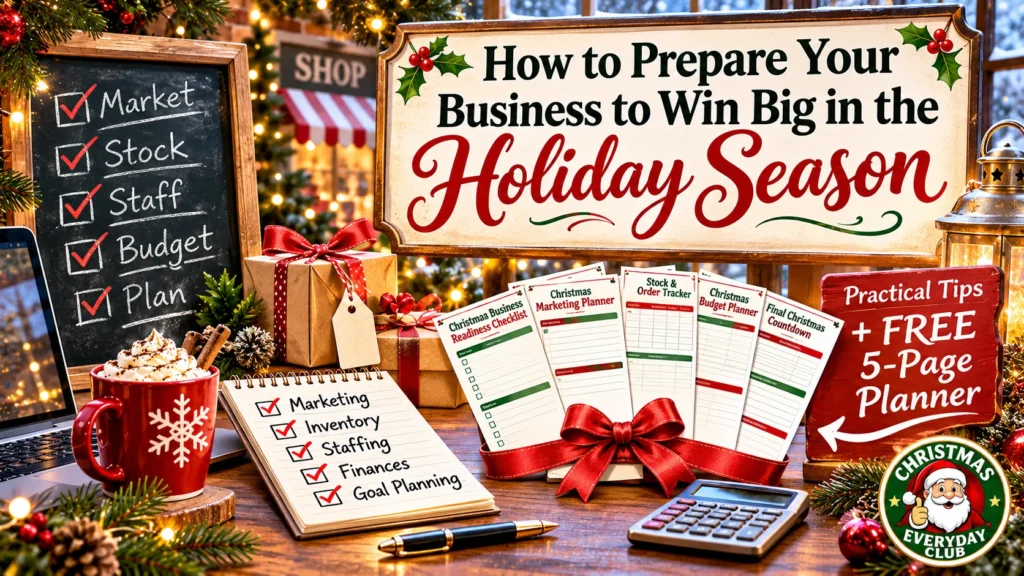
Practical Christmas business preparation tips for small businesses, independent retailers, service providers, and online sellers.
For small business owners, especially local shops, service providers, and online sellers, the final stretch of the year brings real fourth-quarter business challenges.
Seasonal customer demand can spike fast, and without solid Christmas season preparation, the holiday sales surge can create stress instead of sales.
At the same time, cash flow, staffing capacity, inventory decisions, and end-of-year deadlines tend to stack up all at once.
With the right foundation in place early, Q4 becomes a focused push towards clear year-end business goals.
Whether you’re running a small high-street shop, selling handmade Christmas gifts, managing an online business or providing a seasonal service, a little preparation can make a significant difference.
The goal isn’t simply to sell more during Christmas. It’s to manage increased demand, protect your profits, keep customers happy, and finish the year feeling organised rather than overwhelmed.
Good Christmas business preparation starts well before the festive rush, giving you time to organise your marketing, stock, staffing and finances.
Quick Summary: Christmas Readiness Checklist
Before the festive rush begins, focus on five essential areas:
- Marketing: Plan Q4 marketing strategies early to reach customers at the right time with the right offers.
- Staffing: Prepare seasonal staffing plans to cover peak demand while protecting service quality.
- Inventory: Tighten inventory management for Christmas to avoid stockouts and reduce leftover seasonal products.
- Finances: Coordinate tax planning so holiday revenue, expenses and deadlines stay organised.
- Employee wellbeing: Prioritise employee recognition during the holidays to keep morale high throughout the busiest stretch.
A helpful starting point: Write down your three biggest Christmas business priorities. These should guide your decisions about marketing, spending, staffing and stock over the coming weeks.
Tidy Your Tax Files in 15 Minutes With Smarter PDFs
When you’re juggling all the Q4 moves at once, clean tax files can be the difference between calm decision-making and last-minute panic.
A quick dose of tax planning starts with keeping your finances organised, especially as you head into year-end.
One simple system is to gather your key financial records digitally and store them as PDFs.
PDFs are widely accepted and easy to share, which makes them a practical home for documents such as tax returns, insurance policies, invoices and bank statements. Many PDFs are also searchable, so when you need a specific detail quickly, you can find it without digging through folders.
If one of your records is a huge PDF, split it into smaller, clearer files so it’s easier to review or send.
A PDF splitter tool lets you separate pages quickly. Once the new files are saved, you can rename them, download them or share them with others.
If you want a simple way to do that, you can use Adobe’s online PDF splitting tool to organise large documents into more manageable files.
Extra Tip: Create a Christmas Business Records Folder
To make financial administration easier, consider creating a dedicated digital folder for your Christmas trading period.
You could organise it into sections for:
- Sales reports and customer payments
- Supplier invoices and receipts
- Marketing and advertising expenses
- Delivery, postage and packaging costs
- Staffing and payroll records
- Returns, refunds and outstanding orders
Keep sensitive business records in secure storage, with appropriate access controls and backups.
This simple system can save valuable time when reviewing profits, preparing accounts or speaking with your accountant.
With your records tidy and ready to share, you’ll be in a much better position to follow a step-by-step Q4 plan for goals, marketing, staffing, finances and inventory.
Christmas Business Preparation: Your Five-Step Action Plan
This sequence helps you turn organised records into a focused Christmas game plan, so you can make decisions without scrambling.
By moving in order, you’ll know what matters most, what to fund and what to staff before the rush hits.
A successful Christmas business preparation strategy doesn’t need to be complicated. The important thing is to identify your priorities and create a realistic plan you can follow.
Step 1: Review Last Year and Set One Clear Target
Start with an annual goal evaluation.
Compare last year’s holiday sales, busiest days, top products and biggest bottlenecks.
Then choose one primary outcome to chase, such as:
- Increasing revenue or profit
- Attracting new customers
- Encouraging repeat purchases
- Improving order fulfilment
- Increasing bookings or enquiries
Add one supporting goal, such as faster fulfilment or fewer customer service issues.
Keep it simple so every later decision has a clear direction.
Extra Christmas Business Tip
Don’t just look at how much you sold last year. Consider which products or services generated the best profit.
A popular product isn’t necessarily your most profitable one, especially when you account for packaging, postage, transaction fees and promotional discounts.
For example, an independent Christmas gift seller might discover that smaller gift bundles produce a healthier margin than heavily discounted larger products.
Use those findings to decide where to focus your efforts this year.
Step 2: Map Your Holiday Marketing Campaigns to a Calendar
Choose two or three campaigns you can execute well, such as a gift guide, a limited-time bundle or a loyalty offer for past customers.
Put each campaign on a weekly calendar with a start date, the channels you’ll use and one measurement that matters, such as orders, sign-ups or foot traffic.
A practical rule is to start planning your holiday marketing early, giving yourself time to refine your messages before demand peaks.
Make Your Christmas Marketing More Useful
Customers are often looking for solutions during the festive season, not simply more advertisements.
Consider creating content that answers common Christmas shopping questions:
- What can I buy for someone who already has everything?
- What are some affordable Christmas gifts?
- Which products are suitable for families or children?
- What are the final ordering dates for Christmas delivery?
- Can I purchase a digital gift if I’ve missed the postage deadline?
Helpful gift guides, product demonstrations, behind-the-scenes videos and practical Christmas tips can attract attention while building customer trust.
For small online sellers: Pinterest, Facebook, Instagram and short-form videos can help showcase products, but focus on the platforms where your customers are most active rather than trying to post everywhere.
And remember to check that every promotion has a clear end date, accurate pricing and a working purchase link.
Step 3: Plan Seasonal Staffing Around Your Busiest Moments
List the tasks that will spike first, such as packing, customer service, deliveries, in-store support or appointment slots.
Estimate the hours needed per week.
Decide what you’ll hire for, what you can cross-train internally and what you can temporarily simplify, such as fewer custom options or tighter service windows.
Confirm your schedule early so training happens before you’re overloaded.
Don’t Forget Smaller and One-Person Businesses
Not every business has employees.
If you’re a sole trader or run a small home-based business, the same planning principles still apply.
Think about how much you can realistically manage each day.
You might need to:
- Set a daily order-processing limit.
- Introduce earlier deadlines for personalised products.
- Prepare packaging and labels in advance.
- Batch similar tasks together.
- Set clear customer service hours.
- Arrange temporary help if demand increases.
It’s better to communicate realistic delivery or completion times than to accept more work than you can comfortably fulfil.
Step 4: Forecast Inventory, Then Place Smarter Orders
Use your sales history and campaign calendar to predict what will sell, when it will sell and how quickly you can restock.
The core idea behind inventory forecasting is projecting stock requirements ahead of time.
This helps you avoid both stockouts and cash tied up in slow-moving products.
Build a short reorder plan with supplier lead times and a small buffer for your best sellers.
Watch Out for Christmas-Specific Stock Problems
Christmas products often have a limited selling window.
Once the festive season has passed, some items may become harder to sell at full price.
Think carefully before ordering large quantities of highly seasonal products.
For example:
- Christmas decorations may remain popular throughout December.
- Personalised gifts may need earlier ordering deadlines.
- Craft materials may be useful beyond Christmas.
- Digital printables can offer an alternative when physical delivery deadlines have passed.
For businesses that sell both physical and digital products, promoting downloadable alternatives closer to Christmas may help capture last-minute demand.
For service businesses: Replace stock forecasting with capacity forecasting. Review how many appointments, bookings or projects you can realistically complete before Christmas.
Step 5: Finalise the Budget and Lock In Appreciation
Create a Christmas budget that includes marketing spend, extra labour, shipping, returns and a cushion for surprises.
Set weekly check-ins to compare planned spending against actual results.
Reserve a small amount for employee appreciation initiatives, such as meals during peak weeks, spot bonuses or extra flexibility after the rush.
When your team feels supported, execution stays steady even on chaotic days.
Remember to Protect Your Profit
Christmas promotions can increase sales, but discounts can also reduce profit margins.
Before launching an offer, calculate the full cost of delivering it.
Remember to include:
- Product or material costs
- Advertising and marketing
- Packaging and postage
- Payment processing fees
- Staff or contractor expenses
- Refunds and returns
- Unexpected costs
A successful Christmas campaign should support your business financially, not simply generate more orders.
Free Download: Christmas Business Readiness Planner 🎁
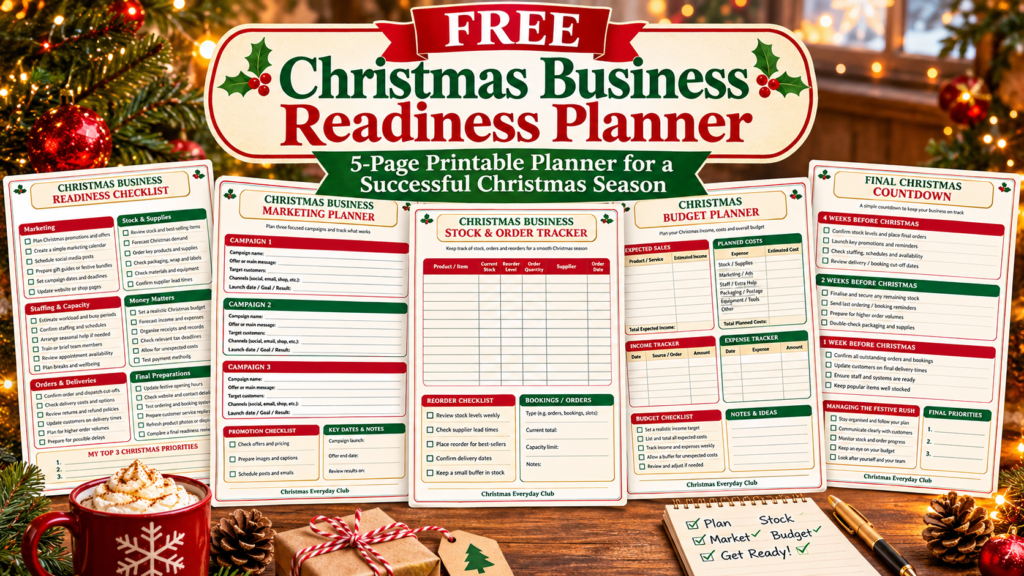
To make Christmas business preparation easier, Christmas Everyday Club has created a free five-page planner to help small business owners organise their marketing, stock, orders, finances and festive deadlines.
To help small business owners, independent sellers and Christmas market traders put these ideas into practice, Christmas Everyday Club has created a free five-page Christmas Business Readiness Planner.
Rather than keeping everything in your head, you can print the worksheets and use them to organise your festive business preparations.
What’s Included in the Free Planner?
1. Christmas Business Readiness Checklist
A practical checklist covering marketing, stock, staffing, finances, orders, deliveries and final preparations.
2. Christmas Marketing Planner
Space to plan three marketing campaigns, record promotional offers, choose marketing channels and keep track of important dates.
3. Stock & Order Tracker
A worksheet to monitor products, quantities and reorder requirements, with an alternative planning section for service businesses.
4. Christmas Budget Planner
Plan your expected income and expenses, track spending and keep an eye on your Christmas budget.
5. Final Christmas Countdown
A preparation checklist covering the final four weeks, two weeks and one week before Christmas, helping you prioritise essential tasks.
Who Is the Planner For?
The printable is suitable for:
- Small business owners
- Etsy and online marketplace sellers
- Independent shops and retailers
- Christmas market traders
- Handmade gift businesses
- Service providers
- Home-based businesses
The planner uses an undated A4 format, so you can use it for future Christmas seasons too.
Get Your Free Christmas Business Planner
You can find this printable in the Cozy Christmas Vault inside the Christmas Everyday Club community.
Our community is free to join and also offers festive activities, creative resources, Christmas inspiration and more.
🎄 Join Christmas Everyday Club and explore the free resources
Christmas Season Prep FAQs for Business Owners
Here are some quick answers to questions that often arise during the busiest months of the year.
What Tax Planning Should I Do Before the Holiday Rush Hits?
Block 30 minutes to review year-to-date profit, payroll and any large purchases you’re considering.
Then confirm deadlines for filings, estimated payments and any year-end moves you want to complete before your books close.
If retirement contributions are part of your financial planning, remember that the applicable rules depend on your country and circumstances.
For UK business owners: Check the relevant HMRC requirements for Self Assessment, VAT, PAYE and Corporation Tax, where applicable. Deadlines depend on your business structure and accounting periods, so don’t assume everything falls due in December. You can use HMRC’s tax deadline checker to help plan ahead.
For US business owners: Review the applicable federal and state requirements, including estimated taxes and any relevant retirement contribution rules.
For significant tax decisions, seek advice from a qualified accountant or tax professional.
How Can I Improve Operational Efficiency Without Burning Out?
Pick one process to simplify, such as batching fulfilment, using templates for customer replies or setting daily cut-offs for custom requests.
Protect focus time by setting clear boundaries so administration doesn’t take over every evening.
For example, a handmade gift seller might dedicate mornings to production, afternoons to packing and a short period each day to answering customer messages.
Having a routine can reduce interruptions and make workloads easier to manage.
What Compliance Items Should I Double-Check for Christmas Promotions?
Make sure your pricing, discount terms, return windows and shipping cut-offs are written clearly wherever customers will see them.
If you sell regulated products or collect sales tax across multiple states, verify that you’re applying the correct rules before advertisements go live.
For UK sellers, review the applicable consumer protection rules, including accurate promotional pricing, delivery information, cancellation rights and refunds. Different rules and exceptions can apply to personalised goods and digital downloads, so check the requirements relevant to what you sell.
Remember that personalised products, digital downloads and other product types can have different rules.
Don’t assume that Christmas sales or discounted products are automatically exempt from normal consumer protections.
How Do I Run a Fast Inventory Audit That Actually Helps?
Do a quick cycle count on your top sellers and highest-value stock items first, then investigate any mismatches immediately.
Confirm what is damaged, what is tied up in returns and what is committed to open orders.
This ensures your reorder decisions are based on stock that’s genuinely available.
For smaller businesses, even a simple spreadsheet or printable stock tracker can help you identify problems before they affect customers.
When Should I Reorder, and How Much Buffer Is Reasonable?
Reorder when projected demand and a small safety cushion indicate that your available stock may run out before your next delivery arrives.
A practical buffer might cover a few peak selling days for your best sellers, while keeping slower-moving products tighter to protect cash flow.
The right amount depends on supplier reliability, delivery times, demand and how quickly you can restock.
What If I’ve Left My Christmas Business Planning Too Late?
Start with the areas that could cause the biggest problems if ignored.
Prioritise:
- Confirming stock or service availability.
- Checking final delivery and booking deadlines.
- Updating customers with accurate information.
- Reviewing your budget and cash flow.
- Promoting products or services you can still reliably fulfil.
Avoid launching complicated last-minute campaigns if your business is already struggling to manage existing orders.
A smaller, well-organised Christmas campaign is often more manageable than a large promotion you cannot deliver properly.
After Christmas: Review What Worked
Christmas business preparation shouldn’t end when the decorations come down.
Once the busiest period has passed, take time to review your results.
Consider:
- Which products or services sold best?
- Which marketing campaigns generated the most useful results?
- Were your delivery and fulfilment estimates accurate?
- Did you order too much or too little stock?
- Which customer questions came up most often?
- Were your staffing and working arrangements manageable?
- What would you change next Christmas?
Record your answers while the experience is still fresh.
Even a one-page review can provide valuable information for the following year’s Christmas planning.
For seasonal businesses, this is also a useful time to organise remaining stock, review supplier relationships and identify products that could be sold throughout the year.
Looking Ahead to Your Own Career Goals?
Christmas isn’t just a time to review your business performance. It’s also a wonderful opportunity to reflect on your personal ambitions, career goals and work-life balance.
If you’re thinking about making changes in the new year, take a look at our article, Before the New Year Begins: Why Christmas Is the Perfect Time to Rethink Your Career.
You’ll also find a free four-page Christmas Career Reflection Planner to help you reflect on your achievements, explore new possibilities and plan your next steps.
Turn Christmas Planning Into Measurable Q4 Wins
The Christmas rush can feel like a moving target. Inventory, staffing, compliance and cash flow all tighten at once.
The path forward is a steady, plan-first mindset: applying Q4 best practices early, reviewing the numbers and making clear choices that build confidence in holiday business planning.
When that approach becomes your default, successful Christmas season strategies stop being last-minute scrambles and start supporting real holiday season goal achievement.
And remember, preparing for Christmas isn’t just about increasing sales. It’s also about creating a business that can handle its busiest period without unnecessary pressure.
By keeping your plans realistic, communicating clearly with customers and staying organised, you’ll give yourself a much better chance of enjoying a successful festive season.
With the right Christmas business preparation, you can reduce last-minute pressure, make better decisions and give your customers a more enjoyable festive experience.
Win the holidays by planning early, focusing on the fundamentals and executing consistently.
And if you’d like a little extra help getting organised, don’t forget to collect your free Christmas Business Readiness Planner from Christmas Everyday Club.
🎄 Here’s to a successful, organised and enjoyable Christmas season!